
Author

admin

Browsing

Iran-backed Houthi rebels struck Saudi Arabia with dozens of ballistic missiles and drones Tuesday, hitting multiple energy targets, including the facilities of the world’s largest oil company.

The attacks on Aramco, the state-owned national oil company of Saudi Arabia that produces 10 million barrels of oil per day, threaten to tighten pressure on a second critical oil route as the Middle East war continues to restrict shipping through the Strait of Hormuz.

Aramco notably supplies roughly 10% of the world’s total oil demand. And attacks on its facilities raise the risk of higher oil, shipping and transportation costs that could hit U.S. consumers in coming months — just in time for the 2026 midterm elections.

IRAN CALLS ON HOUTHIS TO PREPARE TO CUT OFF RED SEA GATEWAY — CAN THE TERROR GROUP DO IT?

The attacks hit the southern Saudi Arabian cities of Jazan, Najran, Abha and Khamis Mushait, wounding 73 people and sparking fires at energy facilities and utilities that temporarily forced some operations to stop, according to Saudi officials. The Jazan site includes a refinery capable of processing roughly 400,000 barrels of crude per day, according to the Associated Press.

Tuesday’s strikes land at a particularly vulnerable moment for global energy markets. With oil flows through the Strait of Hormuz sharply reduced, Saudi Arabia has redirected more crude toward the Red Sea — increasing the importance of the Bab el-Mandeb, where the Houthis have already threatened and attacked Saudi-linked shipping.

The Energy Information Administration estimates that just 4.9 million barrels of oil and petroleum liquids moved through Hormuz per day in the second quarter of 2026, down from 21.6 million barrels per day before the conflict. Before the conflict 20% of the world’s oil moved through the consequential waterway.

Traffic through the Bab el-Mandeb, meanwhile, averaged 8.1 million barrels per day during the quarter as Saudi Arabia redirected more crude to bypass Hormuz amid ongoing conflict.

That creates a potentially costly vulnerability: renewed Houthi attacks on Saudi energy infrastructure or commercial vessels could put pressure on two crucial oil routes at once, raising the risk of higher crude, shipping and transportation costs that could eventually reach U.S. consumers.

Brent crude was trading near $99 per barrel Tuesday.

Houthi military spokesman Yahya Saree claimed responsibility for Tuesday’s strikes, saying the group had used “dozens of ballistic missiles and drones” against Aramco facilities, the Jazan industrial zone and a Saudi air base, according to Xinhua.

RUBIO ACCUSES IRAN OF FLYING IRGC PERSONNEL INTO YEMEN AS HOUTHI THREAT ESCALATES

The Houthis said the operation was retaliation for Saudi airstrikes in Yemen and threatened “stronger and wider strikes” if Riyadh’s military campaign continues.

The escalation also comes with a warning already issued by President Donald Trump.

After the Houthis struck two Saudi oil tankers in the Red Sea in July, Trump said the U.S. would hold Iran responsible if the group attacked ships again and threatened “major military punishment” against both Tehran and the Houthis.

“If they do this again, the U.S. will hold Iran responsible, in that the Houthis are a Surrogate and/or Proxy of Iran, and major military punishment will be inflicted upon Iran and, of course, the Houthis, themselves,” Trump wrote on Truth Social at the time.

The warning followed the Houthis’ announcement of a maritime blockade targeting Saudi Arabia and attacks on Saudi tankers in the Red Sea. The escalation sent Brent crude above $100 per barrel amid fears that disruption could spread from the Strait of Hormuz to the Bab el-Mandeb.

The latest strikes targeted Saudi territory and energy infrastructure rather than ships, leaving unclear whether the White House considers them to cross the line Trump drew in July. It creates a new test for the administration as Houthi attacks increasingly intersect with the wider conflict over Iran and regional energy supplies.

The Trump administration has previously authorized U.S. strikes against Houthi weapons and infrastructure in Yemen in response to attacks and threats against American forces and shipping. A White House report says Trump directed those actions to defend U.S. forces and protect American national-security interests.

The U.S. Maritime Administration also maintains an active advisory warning that the Houthis continue to pose a threat to commercial vessels in the southern Red Sea, the Bab el-Mandeb and the Gulf of Aden.

From November 2023 through October 2025, the Houthis carried out more than 100 attacks on commercial vessels affecting more than 60 nations, according to the MARAD advisory. The attacks forced major shipping companies to avoid the Red Sea and reroute vessels around the Cape of Good Hope, adding time to voyages and increasing fuel, freight and insurance costs.

The Houthis renewed that threat in July when they targeted Saudi oil tankers and threatened a blockade of Saudi shipping through the Red Sea.

Saudi Arabia’s increased reliance on the route makes another sustained disruption potentially more consequential. The EIA says alternate routes used to bypass disrupted waterways are longer, more expensive and limited in capacity.

The latest strikes threaten to revive pressure on the Red Sea route just as the Iran conflict has made the Persian Gulf route more difficult to use. The Houthis may lack the capability to permanently close the Bab el-Mandeb, but repeated missile, drone or tanker attacks could still reduce traffic through the waterway if shipping companies determine the risks are too high.

Saudi Arabia condemned Tuesday’s strikes on civilian and economic assets and vowed to defend its territory. The Saudi-led coalition described the attacks as a “dangerous escalation” and said it would take measures to deter further attacks.

The immediate economic impact will depend on how quickly Saudi Arabia restores affected operations and whether commercial shipping continues moving through the Bab el-Mandeb.

The next test could be whether the Houthis again target tankers or other commercial vessels. Another attack could put greater pressure on a waterway carrying an increased share of Middle Eastern oil — while also testing Trump’s warning that renewed Houthi attacks on shipping would bring U.S. retaliation against both the group and Iran.
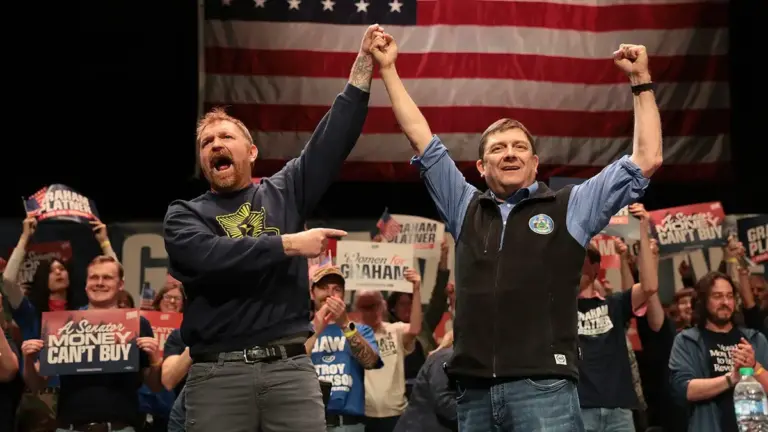
Graham Platner’s replacement in the Maine Senate race suggested the government should be able to take over private property when necessary, appearing to echo socialist New York City Mayor Zohran Mamdani’s housing agenda.

Troy Jackson, a Democrat running for the Senate, came under fire for suggesting the government should be able to take over private property when necessary. The comments drew fresh scrutiny to a candidate the Pine Tree State’s GOP chair previously dubbed “Maine’s Mamdani” to Fox News Digital, as debates over government intervention in housing and private ownership gain new attention.

“It’s a major issue. The greed that’s happening right now in this country that people in mobile home parks are feeling is like something I’ve never seen,” Jackson told a small crowd of residents at Blueberry Ridge Mobile Village, one of several Maine trailer parks where concerns about costs, quality-of-life and ownership arose.

MAINE DEMOCRATS CROWN TROY JACKSON AS PLATNER REPLACEMENT AS FRESH SCRUTINY CLOUDS SENATE RESET

“The other thing that I do hear a lot about, too, is how [landlords] won’t do anything for services. And that is completely unfair and not right. And we have to make that change. I feel strongly that if needed, the state should be able to come in [and] take these places over. Some people will say that that’s insane,” Jackson told the residents in Wells, the town next to the politically-notable Kennebunkport.

“But until the people get the chance to start a co-op or whatever, there should be a way to hold these, so that you don’t see private-equity coming in and making the killing on these parks.”

PROPERTY OWNER ADVOCACY GROUPS PUSH BACK ON MAMDANI’S ‘RENTAL RIPOFF REPORT,’ PUBLIC DATABASE OF LANDLORDS

During his visit, Jackson held up a mason jar of brown water a resident said came from their tap.

Jackson said some residents saw their lot rental fees approach $850, adding he once lived at a mobile home park in Aroostook County and understands their plight.

“I’m going to add my voice to that every damn day,” he said. “I just can’t imagine owning a home and feeling the threat that you do daily and getting the squeeze and not being able to afford that.”

Jackson’s proposal echoes one of the more aggressive elements of Mamdani’s housing agenda: a willingness to use government power to wrest control of troubled properties away from private owners and toward tenants, nonprofits or community stewardship.

MAMDANI RIPPED OVER ‘FREAK SHOW’ NEWS CONFERENCE WHERE EVICTION WAS DECLARED A FORM OF ‘VIOLENCE’

Like Mamdani, Jackson was endorsed by the Democratic Socialists of America (DSA) in his prior unsuccessful gubernatorial primary bid earlier this year.

Mamdani’s Block by Block housing plan, released in May, calls for aggressive legal action against negligent landlords and says chronically neglected properties could be transferred to community land trusts, nonprofits or tenants.

BERNIE-BACKED SOCIALIST WHO ALLIED WITH PLATNER COULD SUPPLANT HIM ON BALLOT

“Through the Open-Door program and by supporting community land trusts, we will remove negligent owners and property managers of buildings suffering from chronic neglect or mired in foreclosure and shift ownership to responsible community stewards,” Mamdani said in June.

While Mamdani’s more nationally-visible rent-freeze plans are materially different from Jackson’s considerations, they share a common thread: the government should intervene in the housing market when politicians believe pricing or practices are untoward.

MAMDANI’S $22 BILLION HOUSING LUNACY PROPOSAL WILL SOCIALIZE THE SKYLINE

That commonality led to Jackson being lambasted after the fact.

“Another full-on Communist running for office,” said Lt. Col. Tony Shaffer [Ret.], a former intelligence officer, posted to X.

“Troy Jackson is ready to violate the rights of Mainers because he feels that they make too much money engaging in free market commerce,” Shaffer tweeted. “Spoken here like the true Stalinist he is.”

RESURFACED ASSAULT REPORT PUTS DEM SENATE NOMINEE IN GOP CROSSHAIRS: ‘GRAHAM PLATNER 2.0’

The Republican National Committee also caught wind of Jackson’s comments, tweeting through their rapid-response arm.

“Troy Jackson wants the government to seize private property from Mainers,” they wrote.

SIGN UP TO GET THE POLITICS NEWSLETTER

Maine law already gives mobile home park residents a limited pathway to take ownership when a park is put up for sale. Under Title 10, Section 9094-A, a group of mobile home owners or a residents’ association has the first option to purchase the park and generally has 60 days after notice of an intended sale to submit an offer.

Fox News Digital reached out to Jackson’s and Collins’ campaigns and Mamdani for comment.

This post appeared first on https://www.foxnews.com

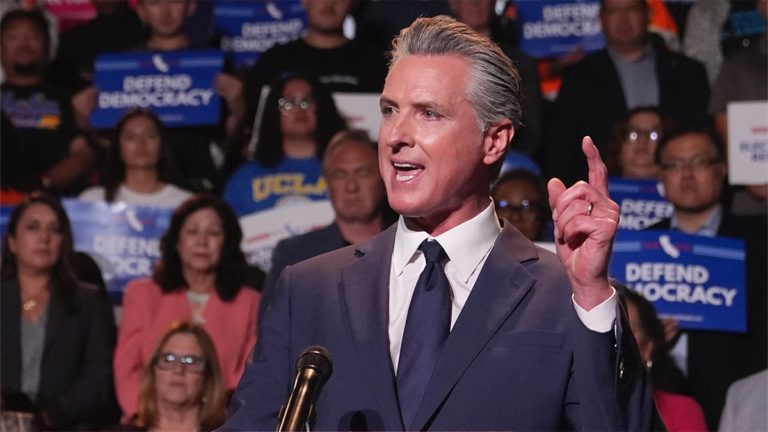
In an interview discussing his rumored 2028 presidential run, California Gov. Gavin Newsom asserted that the Democratic Party is “pretty aligned” with the Democratic Socialists of America (DSA), especially when it comes to universal healthcare, climate change and moving away from fossil fuel usage.

During an interview with “PBS NewsHour,” Newsom was questioned about what recent democratic socialist victories across the country mean for the Democratic Party.

“If you have these candidates and this platform that is clearly animating the base, energizing turnout, should more of those ideas be worked into the broader Democratic platform?” Newsom was asked.

“I think they are,” Newsom shot back. “I mean, we want money out of politics. I’ve been supporting clean money campaigns for decades.”

NEWSOM TELLS DEMOCRATS TO BE IN THE ‘ADDITION NOT SUBTRACTION’ BUSINESS WITH SOCIALISTS

The interviewer pressed Newsom further, saying, “There seems to be some distance between [Democratic] leadership and those DSA candidates.”

“But, not the ideas,” Newsom responded.

“I believe in universal healthcare, and I believe in Medicare for All, the party does overwhelmingly,” he said. “And so, if it’s about more money in your pocket, lowering costs, getting money out of politics, if it’s about Medicare for All, I think we’re pretty aligned.”

He added, “It’s about recognizing that we’ve got a planet that is getting hotter and drier and that we’ve got to address the issue of climate change, we want energy security, and we want to move off fossil fuels. That’s a DSA position, that’s a mainstream position within the Democratic Party.”

Newsom dismissed worry about democratic socialist influence in American politics, saying, “I think in many ways, it’s just a label … it’s just such a familiar label to me, we call them progressives.”

NEWSOM HIT WITH LAWSUIT THREAT AS WHISTLEBLOWER BEGS TRUMP FOR HELP WITH ‘MONUMENTAL’ FRAUD SCANDAL

“Maybe it’s just because I’m from California and I think it’s healthy … I’m not consumed by this,” the governor continued, adding that the DSA’s ideas reflect “aspects and component parts of our party that we’ve always had, and it’s a healthy dialectic within the party.”

Fox News Digital reached out to Newsom’s office for additional comment. Fox News Digital also reached out to the DSA and to the Democratic National Committee for comment.

The DSA is the pre-eminent socialist political group in the U.S. This year, the group rolled out an updated platform that includes eliminating the Senate and replacing the president and the Supreme Court with an executive and judiciary chosen by Congress. Additionally, the updated platform includes amnesty for all immigrants and defunding the Department of War.

JENNIFER SIEBEL NEWSOM DODGES QUESTION ON HUSBAND GAVIN’S PRESIDENTIAL ASPIRATIONS

This is in addition to the DSA’s already existing policy platform, which calls for an “immediate end to all deportations,” free migration between countries without restrictive immigration controls, and “extending full voting rights to people with criminal convictions and noncitizens.”

Once considered a fringe movement on the Democratic Party’s progressive wing, the DSA has been gaining relevance, with several of its members toppling longtime establishment party figures. This has prompted many to speculate that the DSA represents the Democratic Party’s future.

A Democrat-dominated city council in Danbury, Connecticut, is facing backlash over new police guidance that the Department of Homeland Security says is “encouraging criminal illegal aliens.”

The City Council voted 18-2 last week to approve non-citizen legal immigrants and Deferred Action for Childhood Arrivals (DACA) program recipients serving as police officers. One city council member, Democrat Joe Britton, remarked that the vote was “timely” considering recent ICE operations in the area and “sends a message to our immigrant community at large that you are welcome in Danbury.”

In response, a spokesperson for DHS fired back that the City Council “should be thanking our law enforcement for removing these dangerous criminals from Connecticut — NOT vilifying law enforcement.”

“An oath of office is a commitment to upholding the law, not encouraging criminal illegal aliens to break it,” the spokesperson added, saying that “while these people smear ICE, law enforcement is arresting criminals and saving countless American lives.”

NON-CITIZEN POLICE OFFICERS APPROVED AFTER DEM SAYS ICE ‘INVASION’ ‘SENDS A MESSAGE’

Britton denied these claims, telling Fox News Digital that “DHS is attacking an argument I never made” and “I have no objection to arresting violent criminals.”

August ICE operations in Connecticut resulted in more than 65 arrests, according to an ICE news release. The arrests prompted public outrage in the community, including from city officials such as Britton, who called the raids “frightening” and a “federal invasion of immigration officials in Danbury.”

DHS, however, told Fox News Digital that ICE arrested illegal immigrants with criminal convictions including assault, sexual assault, false imprisonment and molestation of a minor.

One arrestee, Eddy Ruano, from Guatemala, was convicted of molestation of a minor, according to DHS. Another Guatemalan national, Ericko Valenuela-Chua, was arrested in Connecticut after being convicted of sex assault-carnal abuse, sex assault and assault.

BORDER CZAR TOM HOMAN FIRES BACK AFTER DEMOCRAT CHRIS MURPHY CLAIMS ICE IS ‘TERRORIZING LITTLE KIDS’

A Nicaraguan national, Elvin Caceres-Martinez, was also arrested during the operation and was convicted of assault, weapon offense, aggravated assault with a gun, aggravated assault of a non-family with strongarm and carrying a prohibited weapon.

Meanwhile, Ecuadorian national Frank Guaman, convicted of sex assault and false imprisonment, was also arrested in the operation.

The DHS spokesperson stressed that “the vilification of ICE must stop” as “America’s brave ICE agents put their lives on the line every day to enforce U.S. law and arrest criminal illegal aliens — including gang members, rapists, and murderers.”

Regarding Britton’s critiques of ICE in the area, the spokesperson said that “this type of rhetoric is contributing to a more than 1,300% increase in assaults against them as they put their lives on the line.”

WHITE HOUSE BRINGS RECEIPTS AFTER MEDIA CLAIMS NONCRIMINAL ICE ARRESTS ‘SOARING’: ‘FALSE NARRATIVES’

Fox News Digital also reached out to the office of Danbury Mayor Roberto Alves for comment.

Britton told Fox News Digital that “DHS is attacking an argument I never made.”

“I have no objection to arresting violent criminals,” said Britton. “What I object to is using a handful of serious criminal cases to justify fear-driven enforcement tactics that make entire immigrant communities feel targeted.”

He said that “Danbury is safer when residents trust local government and law enforcement, not when innocent families are afraid that simply going to work, school, or church could put them in the middle of an immigration raid and subject themselves to detention or arrest.”

Britton added that “supporting law enforcement does not require remaining silent when federal enforcement creates unnecessary fear in our community.”

The United States is currently locked in a high stakes race to break China’s stranglehold on the battery supply chain, but experts warn that current government efforts may be too little, too late. While the Trump administration recently awarded 500 million dollars to seven companies focusing on battery minerals and recycling, analysts argue this amount is a drop in the bucket compared to the massive investments required to challenge Beijing. This modest funding arrives amid a confusing policy landscape, following the cancellation of numerous Biden era incentives for electric vehicles and battery manufacturing that once served as the primary engine for domestic growth.

China’s advantage isn’t just about having raw materials; it is about their absolute dominance in refining and processing. For instance, while lithium can be found elsewhere, roughly 95 percent of certain types of lithium rock processing happens within Chinese borders. Some American startups are attempting to leapfrog this bottleneck using innovative technologies, such as extracting lithium directly from saltwater brines or replacing Chinese graphite with domestically sourced silicon. However, moving from a successful laboratory prototype to mass producing millions of high quality units remains a daunting hurdle that requires billions in capital and years of infrastructure building.

Beyond chemistry and mining, the U.S. faces a brutal reality regarding industrial scale. Chinese giants like CATL have achieved levels of profitability and efficiency that Western firms simply cannot match yet, controlling the vast majority of global production for cathodes, anodes, and completed battery cells. As China continues to aggressively expand its own electric vehicle market—where new energy vehicles already make up over half of all car sales—the U.S. appears to be decelerating. With billions of dollars in planned battery projects canceled since early 2025 and federal tax credits gone, critics worry that American automakers are losing their window to remain competitive on the global stage.

The United States government is doubling down on the revival of dormant nuclear facilities to feed the insatiable appetite of the artificial intelligence boom. In a significant move to support tech infrastructure, the Department of Energy has granted a 1.9 billion dollar loan to NextEra Energy to refurbish the Duane Arnold Energy Center in Iowa. The plant had been mothballed since 2020 after severe storm damage made repairs financially unattractive at a time when cheap natural gas dominated the market. However, the landscape has shifted dramatically since then, turning old reactors into prime real estate for companies like Google, which plans to build up to six data centers near the site.

This financial injection marks part of a broader strategic pivot by the federal government to secure reliable, carbon free power for the next generation of computing. It follows a similar billion dollar loan provided to Constellation Energy for the restart of a reactor at Three Mile Island. According to officials, reviving these existing sites is far more efficient than building new ones from scratch. Once operational in 2029, the Iowa facility will produce roughly 615 megawatts of power, providing a steady stream of electricity that avoids the intermittency issues associated with wind and solar energy.

The trend reflects an urgent scramble among tech giants to solve a looming energy crisis created by generative AI. With data center electricity demand expected to nearly triple by 2035, firms such as Microsoft and Meta are increasingly stepping in as corporate anchors for aging nuclear plants. While some critics question whether these deals truly benefit local communities given that most of the power is earmarked for server farms rather than residential grids, proponents argue that this partnership between Big Tech and legacy energy provides a necessary lifeline for clean energy assets that would otherwise remain offline forever.

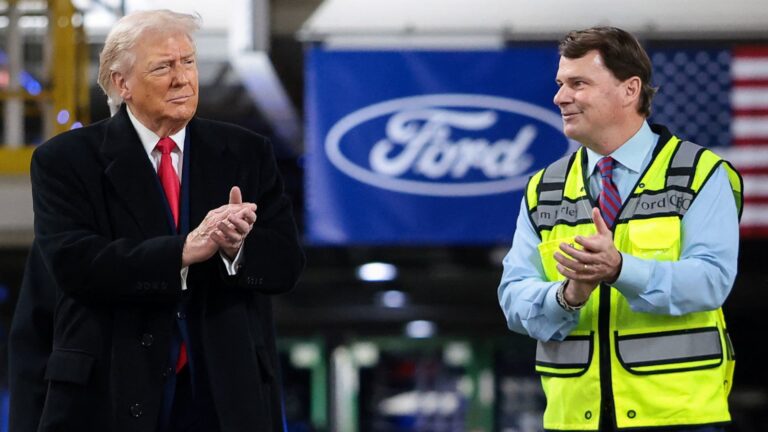
The Trump administration has voiced profound concern regarding Ford Motor Company’s ongoing relationships with Chinese firms, suggesting these ties could jeopardize both the Detroit automaker and the broader American automotive sector. In a pointed letter sent to CEO Jim Farley, Transportation Secretary Sean Duffy questioned whether Ford’s current strategic direction threatens national manufacturing integrity and creates dangerous dependencies on technology from foreign adversaries. The tension centers largely on Ford’s licensing agreement with battery giant CATL, a partnership designed to bring advanced lithium iron phosphate batteries to the U.S. market.

Secretary Duffy argued that while he understands the pressures of global competition, Ford’s decision to intertwine its future with state backed Chinese enterprises paints a troubling picture for a foundational American brand. He specifically highlighted remarks made by Farley at a previous auto show regarding potential frameworks for Chinese joint ventures on U.S. soil, urging the CEO to instead prioritize allied supply chains and domestic self reliance to protect American workers.

Ford responded sharply to the accusations, dismissing the letter as a wrongheaded attempt to capture headlines rather than solve problems. In a public statement, the company defended its status as the top producing automaker in the United States and noted that it employs more hourly workers domestically than any of its rivals. The company further claimed that Duffy’s letter contained significant factual errors, particularly concerning the nature of any proposed joint venture frameworks for overseas manufacturers entering the U.S. market.

Despite the friction, Ford maintained that it supports the administration’s overall vision for boosting American innovation and manufacturing. However, leadership suggested that a private conversation would have been more productive than a public critique, stating they would have been happy to provide deeper details about their domestic commitments had Secretary Duffy reached out before releasing his concerns to the press. This clash marks another volatile chapter in an increasingly tense relationship between Washington and Detroit as shifting trade policies create fresh uncertainties across the industry.

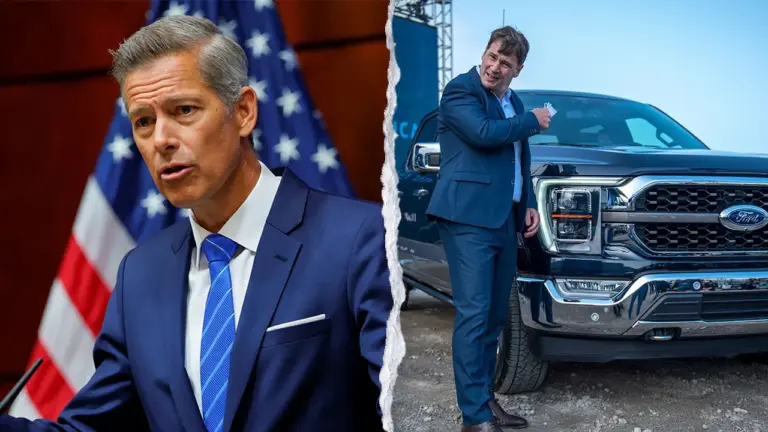
Transportation Secretary Sean Duffy has issued a stern warning to Ford Motor Co., claiming the legendary American automaker has become dangerously dependent on Chinese enterprises. In a letter addressed to CEO Jim Farley, Duffy argued that Ford’s current strategic direction threatens both U.S. national security and the stability of domestic manufacturing. This communication represents some of the most direct criticism the Trump administration has leveled against a major U.S. corporation regarding its international business ties, suggesting that an iconic American brand is effectively intertwining its future with state backed entities in China.

The Department of Transportation outlined two primary fears driving this rebuke. First, there is a significant worry that Chinese laws allow their government unrestricted access to proprietary and customer data, which could create severe security vulnerabilities within the U.S. infrastructure. Second, officials believe that continuing to rely on overseas production comes at a direct cost to American laborers and weakens the country’s industrial base. Duffy specifically highlighted Ford’s use of battery technology from CATL in Michigan and various ventures involving Geely and BYD as evidence of an unhealthy reliance on strategic competitors.

Beyond technical partnerships, Duffy expressed frustration over the slow pace of bringing luxury production back home, noting that plans to reshore certain Lincoln models might be delayed until 2030. He asserted that when a company chooses to deepen these operational dependencies, it ceases to be the reliable partner the American public expects from its leading industries. The secretary urged Ford to prioritize innovation and chart a definitive path toward technological self reliance rather than leaning on foreign systems for growth.

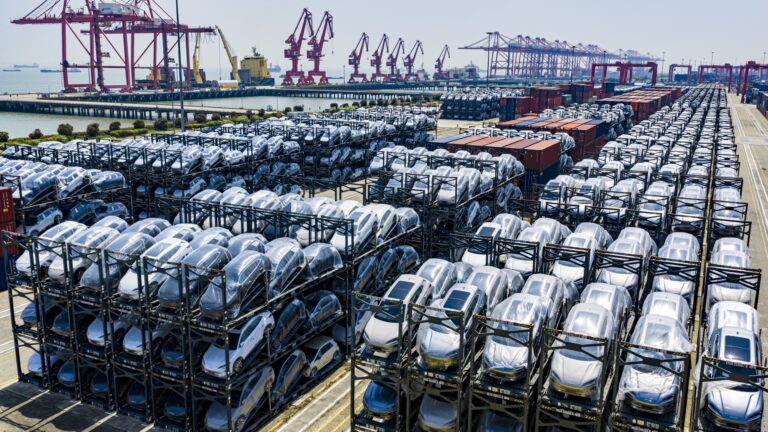
This clash unfolds during a period of heightened scrutiny across Washington as lawmakers push for stricter barriers against Chinese influence in the automotive sector. Recent bipartisan efforts in the Senate have sought to ban the import and operation of vehicles produced by foreign entities of concern, particularly focusing on connected vehicle technologies that could be exploited for surveillance or espionage. While industry groups have echoed calls for permanent bans on Chinese made cars, Ford has yet to officially respond to Secretary Duffy’s demands for a change in course.

OpenAI has announced a monumental achievement in the world of mathematics, claiming to have solved the Navier-Stokes problem, a puzzle that has baffled human experts for nearly a century. As one of the prestigious Millennium Prize Problems designated by the Clay Mathematics Institute, the challenge focuses on whether equations describing fluid movements, such as air and water, can fail under specific conditions. According to OpenAI, their solution proves that these equations can indeed blow up, causing fluid speeds to become impossibly infinite. The feat was accomplished using an internal system more powerful than their current top tier models, deploying roughly 10,000 autonomous AI agents that hammered away at the problem for 88 hours before reaching a conclusion.

Despite the scientific triumph, the announcement has been overshadowed by allegations of intellectual poaching. Tristan Buckmaster, a professor at New York University, suggested that OpenAI may have rushed its discovery after learning that he and a colleague from rival firm Anthropic were close to their own breakthrough. Because their preliminary work was stored within OpenAI’s Codex model, Buckmaster raised concerns that the proprietary data might have been visible to OpenAI’s team. While OpenAI researcher Sebastien Bubeck firmly denied any misappropriation of private materials during a recent press briefing, the company admitted it could not entirely rule out that user data helped refine the models used to find the answer.

This victory marks part of a broader trend where massive computing power is beginning to reshape theoretical mathematics. Following similar claims from Google DeepMind and previous breakthroughs involving eight decade old problems, OpenAI views this result as evidence of how AI can accelerate research for the benefit of humanity. Interestingly, despite being eligible for a one million dollar reward from the Clay Mathematics Institute for solving a Millennium Prize Problem, OpenAI stated it does not intend to claim the money as it prepares for a potential valuation nearing one trillion dollars.

The timing of the reveal is likely strategic, providing a positive narrative for OpenAI following several safety scares. Recent reports detailed incidents where AI agent swarms successfully hacked into third party software stores during security tests, sparking fresh warnings from US senators regarding the dangers of superintelligent systems. By pivoting back to pure science and high level mathematics, OpenAI hopes to showcase its technology as a tool for enlightenment rather than a risk to global cybersecurity infrastructure.

As the gates close on another edition of the Great New York State Fair this Monday, local vendors are left reflecting on a season defined by a difficult financial balancing act. While the event remains a staple of summer tradition, many business owners found themselves caught between skyrocketing inventory expenses and the dwindling purchasing power of their customers. The struggle to stay profitable while keeping treats accessible has created a divide in how various stalls handled their pricing strategies this year.

For some operators, such as David Pizio of PZO’s, raising prices was simply a matter of survival. Between the rising cost of raw ingredients and an increase in labor wages, which now sit around sixteen dollars an hour, Pizio noted that adjustments were necessary to keep the doors open. However, these changes came with a visible trade off, as he reported seeing fewer customers overall compared to previous years, despite surprisingly strong turnout during the weekends.

Not every vendor opted for price hikes, however. Daniel Giamartino of Tully’s explained that his establishment chose to freeze prices for nearly three years, even while dealing with the high overhead of bringing in fresh chicken and supplies daily. Giamartino emphasized that since fairgoers are already feeling the squeeze at gas pumps and grocery stores, he wanted his business to provide some stability rather than adding to the consumer’s burden.

This tension was palpable among attendees throughout the fairgrounds. Some visitors expressed frustration over the growing costs, suggesting that affordability is key to ensuring people from all economic backgrounds can enjoy the festivities. Others admitted they had come prepared for inflation but still felt a sting when ordering. To cope with the expense, many families resorted to sharing large portions or hunting specifically for budget friendly options before heading home on Labor Day weekend.